AI is becoming an increasingly valuable technology for the maritime sector, delivering increased efficiency, improved safety, and a more future-proof fleet in both the commercial and military sectors. AI in the maritime industry has had a transformative effect on how ships are operated, and in this article, we’ll take a more in-depth look at how that applies to the modern fleet.
We’ll look at the unique challenges the maritime industry faces and how AI can address them, including external influences such as rising fuel costs and the environmental considerations now imposed on the sector. We’ll also look at the key AI technologies used and how they benefit the operations of a modern ship.
How big is AI in the maritime industry?
A recent report by Lloyd’s Register has shown just how rapidly the AI market in the maritime industry is growing. Estimated at $4.13 billion in 2024, the sector is predicted to grow by almost a quarter over the next five years. And if the exponential rise of AI has taught us anything, it’s that those figures may well be on the conservative side.
In 2024, over 420 organisations reported that AI now plays a significant role in their operations. Maritime artificial intelligence has also spawned a plethora of new businesses, startups and SMEs, all focused on delivering AI maritime technology to the sector. Maritime artificial intelligence is, without doubt, a huge growth area, intent on future-proofing civilian and cargo vessels as well as military and coastguard operations. In addition, AI could lead to fully autonomous ships in the future.
How can AI technology be used in maritime environments?
Maritime AI enables ships and ports to operate more efficiently, improving safety and sustainability. Beyond operational systems, it can also analyse vast amounts of data very quickly, from weather analysis to shipping positions. This ability to analyse real-time data streams allows port controllers, ship captains, and coastguard crews to operate safely and efficiently in increasingly busy waters. It also makes complex decision-making easier and faster.
For naval and defence operators, maritime artificial intelligence represents the cutting edge of nautical warfare, allowing systems to work in tandem and providing crews with the most up-to-date information. AI’s ability to process huge amounts of data very quickly in real-time helps ensure operational information is prioritized and communicated effectively.
A selection of the different applications for maritime artificial intelligence includes:
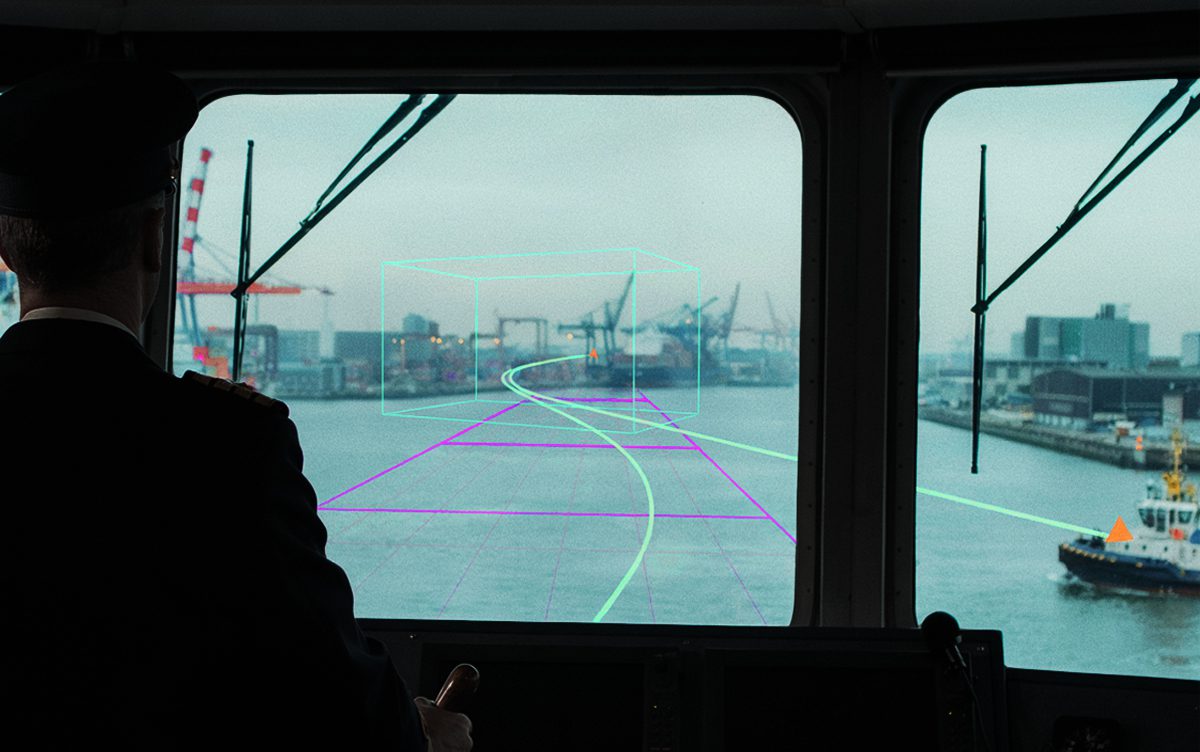
- Autonomous navigation – AI can be integrated into many legacy systems such as radar, LiDAR, AIS, satellite links, and onboard computer systems to provide a joined-up navigational platform for steering vessels, obstacle detection and avoidance (especially useful in the far north where ice flows and icebergs are a real hazard to shipping), and route decisions.
- Dynamic route optimisation – Because AI uses machine learning, complex integration of a wide range of data can be simultaneously combined to optimise the safest, most fuel-efficient, and fastest route.
- Predictive maintenance – AI in aeronautical applications has been proven to be very successful in keeping aircraft, particularly helicopters, well maintained. The same application can be used in marine scenarios, enabling operators to analyse everything from temperature, vibration and pressure data to identify possible early signs of mechanical or electronic failure. This allows repair crews to stop minor issues from becoming major ones, cutting downtime and avoiding expensive or even potentially life-threatening engine failures at sea.
- Safety, risk management, and collision avoidance – While it’s important to use AI in conjunction with human elements for safety and risk management, it provides useful tools for hazard detection, monitoring hazardous materials, and collision avoidance, especially when partnered with radar and AIS data.
Core AI technologies used in the maritime industry
Maritime artificial intelligence isn’t a single entity. It’s made up of a collection of technologies, each with a specific role to play, but all of which can be combined into a legacy system to update and improve a vessel’s performance. These include:
- Machine Learning – Machine learning can be used to analyse complex ocean data, such as current charts, analyse oceanographic and environmental data, and detect patterns in data from satellites and other sources faster than human analysts.
- Deep Learning – Deep learning gives operators instant access to high-accuracy perception and decision-making support systems. This is particularly important when relying on visual data, or information gleaned from highly complex or multiple sensory sources such as radar, LiDAR, multi-spectral cameras and AIS. It can assist in collision avoidance and course recalculation to create more efficient routes.
- Computer vision – Computers are now capable of ‘seeing’ far more, which is essential for autonomous marine drones and semi-autonomous vessels. It can help with visual hazard perception as well as port assistance during docking and manoeuvring in ports. It’s often combined with radar and LiDAR to enhance situational awareness.
- Natural Language Processing – NLP creates a strong link between human operators and maritime systems, improving communication, decision‑making, safety, and digitalisation. It interprets text, speech, and specific maritime data and puts it into a language that AI systems can understand.
- IoT Sensors -IoT sensors form the foundation of AI maritime technology. They provide real-time data streams that can be used to create navigation, surveillance, environmental monitoring, and predictive maintenance schedules through constant capture of operational data from multiple sensory inputs.
- Digital Twins – A maritime digital twin is a live digital model of a ship, port, or marine system. This model uses real‑world data to monitor and simulate scenarios, allowing more focused and data-driven decision‑making. It connects physical assets with digital analytics using IoT sensors, SCADA systems, AIS feeds, weather data, and onboard equipment.
- Edge AI -Edge AI relocates the gathering and analysis of intelligence away from the Cloud and back onto vessels and IoT devices. This cuts down on any delays accessing vital data, allowing maritime operators to analyse data that is directly relevant to them and respond instantly. This is particularly useful if connectivity to the Cloud has been lost (for example, as a result of bad weather or a remote location).
- Satellite Intelligence – Finally, never underestimate the importance of satellite intelligence in the marine sector. Satellite data, such as to-the-minute weather reports, identification of obstacles such as ‘rogue’ icebergs, and details on efficient routes or search patterns, are enhanced using satellite technology.
The benefits of using AI technology in maritime environments: How AI is improving maritime industries
The future is developing rapidly for the maritime industry, and AI is at the cutting edge of all advancements. Maritime artificial intelligence can tackle a variety of challenges, both at sea and on land. The concept of fully autonomous vessels has the potential to revolutionise border patrols and even cargo transportation across vast distances. The AI technology used by the military in drone operations could translate just as easily over to maritime applications, enhancing the work carried out by manned platforms such as helicopters and high-speed response RIBs.
Tactically, AI delivers a wealth of tools through improved situational awareness, and combined with Edge AI, can be focused on specific operational areas. Systems such as FlySight’s OPENSIGHT are crucial in enhancing tactical awareness in maritime environments by using turnkey solutions like dehazing to improve visibility even in poor conditions.
On land, port operations can be streamlined, as well as increasing safety parameters for both dock crews and ships arriving and departing. Marine artificial intelligence can take into account tidal factors, seasonal variations, and other variable factors such as military and coastguard operations that often operate out of civilian ports, too.
Reducing running costs
For commercial operators, every cost matters. The ability to reduce running costs in what is a very high-cost method of transport means that greater profits can be gained without ‘cutting corners’ or putting the safety of the crew or vessel at risk. AI can help to identify where waste or inefficient running is driving up costs, and where route optimisation can save both time and money.
For military applications, reducing running costs without compromising safety means that more time can be spent patrolling or carrying out defensive manoeuvres. The benefits of reduced running costs for coastguards mean more coverage and greater security for coastal areas, more rescue missions, and more lives saved.
Better fuel efficiency
While this technically falls into the same category as greater all-round efficiency, fuel economy does deserve to be looked at in isolation, as it has such a profound effect on overall operations. Ships are not known for their fuel frugality. AI can look at a system and identify defining factors such as the most efficient speed for open water, optimising voyages and routes to utilise things like ocean currents, and predictive maintenance to keep engines running as efficiently as possible.
Increased safety
Safety considerations are of primary importance at sea. The maritime environment can be extremely unforgiving, putting lives in danger. Marine artificial intelligence can help with real-time data analysis of weather patterns and support route planning around developing storms. For coastguards, AI-powered data assessment ensures the safety of crews, allowing them to assist more effectively in SAR operations.
Lower emissions
Diesel engines are notoriously polluting, and as most vessels run using diesel engines, anything that can help to lower emissions is to be embraced. Artificial intelligence in marine environments can help ensure engines produce fewer emissions through leaner, more efficient operations.
Faster decision-making
This is particularly important for military vessels and Coastguard monitoring and SAR operations. The ability to crunch vast amounts of data very quickly, eliminating ‘background noise’ and focusing on the important data, makes AI an invaluable tool in the decision-making process. For border patrols, drug and smuggling enforcement, and both offensive and defensive military operations, faster decision-making keeps the lines of communication open and improves mission outcomes.
Improved surveillance capabilities
Better surveillance over extremely challenging maritime terrain puts marine artificial intelligence systems at the forefront of mission decision-making. Even when conditions are not optimal, such as dense fog or haze, AI can work with augmented reality software such as FlySight’s OPENSIGHT Dehazing solutions to improve visibility in degraded conditions, identify targets, and monitor them from a distance using a direct link between aerial platforms, marine vessels, and onshore command centres.
Maritime challenges addressed by marine artificial intelligence include managing rising fuel costs, predicting and addressing crew shortages, and ensuring safety improvements are put in place exactly where they’re needed. In addition to improving operational efficiency, AI in the maritime industry can also ensure that operators adhere to all current and future environmental regulations by assessing data and comparing it against the operator’s regulatory obligations.
How FlySight’s OPENSIGHT is introducing AI to maritime operators
FlySight’s innovative OPENSIGHT and its turnkey solutions are probably best known for their integration into helicopter legacy systems. However, the same invaluable AI and Enhanced Reality technology that makes them so suitable for aerial military, civilian, and SAR platforms also makes them equally useful in maritime applications.
Designed to improve tactical awareness in maritime environments and provide both aircrews and ground controllers with real-time data, OPENSIGHT delivers exceptional access to multi-spectral data. This in turn allows operators to use already-familiar legacy systems to integrate high-tech AI marine technology into their decision-making processes, improving situational awareness and raising both mission success and operational efficiency.
You can find out more by exploring our informative articles on multisensory fusion onboard helicopters in marine environments, or examine how OPENSIGHT is saving lives with maritime search and rescue operations. And as for the future, we’re delving into how OPENSIGHT is creating more reliable communications for underwater navigation and coordination that could, in time, lead to the successful use of autonomous surface and underwater vehicles.
Get in touch to find out more about FlySight OPENSIGHT’s maritime use cases and AI capabilities. More information is available on our OPENSIGHT page, or talk to one of our team today.