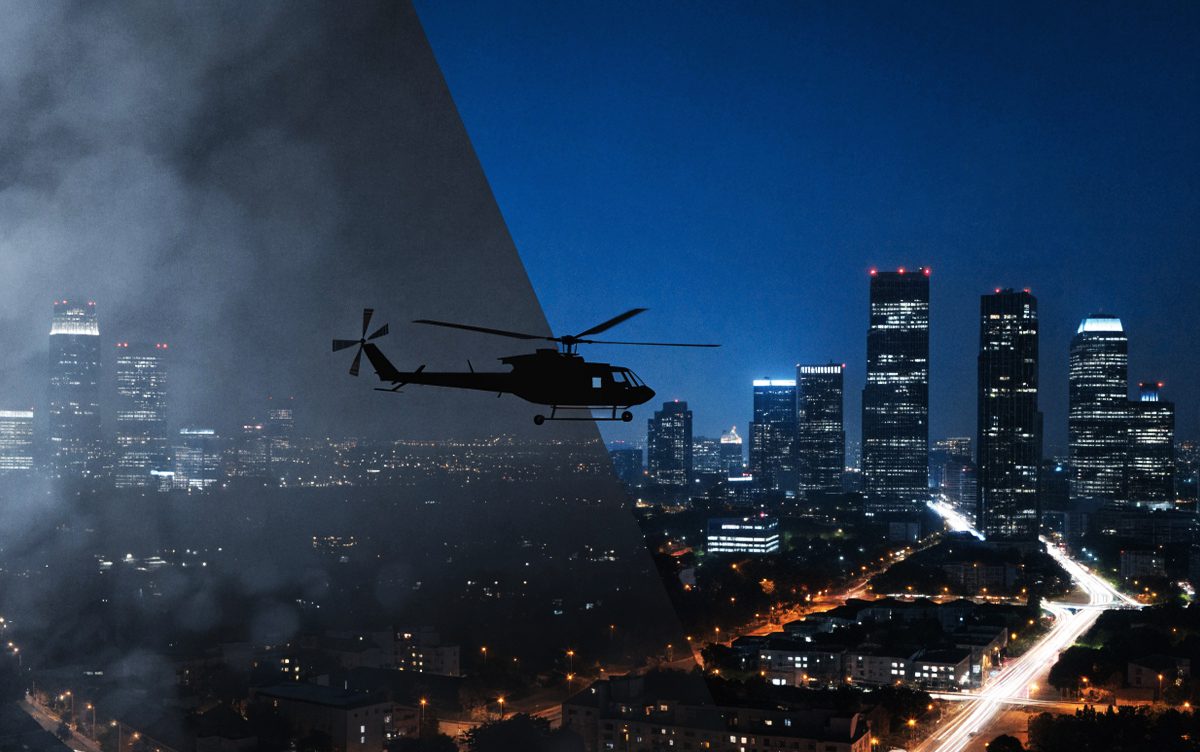
Is helicopter night flying practical, economical, and, most importantly, safe? The simple answer is yes: helicopters are perfectly capable of operating at night and in degraded visual environments (DVEs). The challenge is to make it as safe as possible for everyone concerned, using technology designed for low-visibility helicopter operations. From night-vision goggles to cutting-edge AI-enhanced consoles using Augmented Reality, multispectral cameras, and AI image processing, night flights can be safer and more practical with appropriate technology and training.
In this article, we’ll take a more in-depth look at how situational awareness can be improved during helicopter night flying. We’ll look at the hardware requirements, including cockpit lighting, as well as the regulations governing night helicopter flying. We will also discuss the particular challenges pilots and operators face, and how systems such as FlySight’s OPENSIGHT Mission Console can play a significant role in nighttime and DVE operations.
What are the challenges of flying a helicopter at night and in degraded visual environments?
The most obvious challenge concerning low-visibility helicopter operations, whether that’s due to bad weather, degraded visual environments, or nighttime operations, is visibility. For helicopters, there are unique challenges that significantly affect safety and spatial awareness.
These include:
- A limited natural horizon – At night or in DVEs, the loss of the natural horizon can have significant consequences. Once the horizon becomes indistinct, a pilot loses their primary visual reference for judging attitude, orientation, and motion. This, in turn, can dramatically increase the risk of spatial disorientation and is one of the most commonly cited contributors to helicopter accidents at night.
A natural horizon is essential for a pilot to calculate bank angle, pitch attitude, and pitch, climb or descent. Without a clear visual horizon, a pilot is forced to rely on instrumentation for these calculations, placing greater pressure on the operator and increasing stress and fatigue.
- Reduced depth perception – Accurate depth perception relies on clear visual cues. In low light, whether that’s darkness or DVE, visual resolution is compromised because the human eye works differently in low light. This makes it harder to judge distance, closure rate, height above terrain, and proximity to obstacles.
In turn, this impacts actions such as the ability to judge a helicopter’s operational height relative to the terrain, reduced obstacle awareness, and difficulty perceiving closure speeds and distance during landings.
- Spatial disorientation – the leading contributing factor of helicopter accidents in DVEs. Research by the UK’s Civil Aviation Authority has shown a strong correlation between the loss of visual cues and pilot disorientation, particularly at night or in low-visibility conditions. It can create illusions, including the feeling that the platform is level while banking, a sensation of climbing while descending, and false sensations of rotation, all of which can quickly lead to a loss of control.
Increased pilot workload – A loss of visibility means the pilot has to rely more on instrumentation, which, in turn, dramatically increases the pilot’s workload. In DVE, that workload can be almost overwhelming as pilots have to constantly cross-check information on instrument banks and make continuous manual corrections to keep the aircraft stable.
How Situational Awareness technology can help
Whereas before, low light levels and poor visibility made flying helicopters at night or in DVE a real challenge, modern technology is proving incredibly helpful. Situational awareness technologies for helicopters provide the equivalent of an ‘AI co-pilot’ and a raft of sensors to enhance poor visibility through systems such as FlySight’s OPENSIGHT Enanched Reality System with Dehazing package. Let’s take a closer look at how low-visibility helicopter operations can be enhanced with situational awareness technology.
Multispectral sensors
While standard cameras are great for daytime or clear-weather operations, low-light or poor-visibility conditions require more complex, multispectral sensors to capture clearer images. Covering a wider range of the spectrum, including visible, infrared, and thermal bands, multispectral sensors improve visibility in a wide range of conditions, so pilots can see key details, even if visual cues disappear. This dramatically improves situational awareness and operational considerations such as landing safety and obstacle avoidance.
Augmented Reality technology
Augmented or Enhanced Reality is one of the most powerful tools in an operator’s arsenal for improving situational awareness. AR can restore visual cues that pilots tend to lose at night or in adverse conditions such as fog, haze, or dust. It overlays synthetic terrain, sensor imagery, flight symbology, and obstacle warnings directly into the pilot’s field of view, often using a heads-up display or other intuitive format. This dramatically improves situational awareness and can help reduce workload when effectively implemented, reducing the chance of fatigue and pilot error.
Advanced mission console systems
AI image processing and enhancement have revolutionised modern flight. The capability of AI to gather and process vast amounts of data makes it a powerful decision-support tool for the modern helicopter crew. However, rather than a single system, advanced mission console systems such as FlySight’s OPENSIGHT Mission Console are adaptable and customisable. They use plug-ins that adapt an onboard system to a user’s specific requirements.
For example, Search & Rescue operators will benefit from video processing algorithms. These correct and enhance images, including dehazing and fog-suppression software, giving a pilot a clearer view of the search area. Coupled with information from multi-spectral imaging, including heat sensors, it speeds up the rescue process and makes coordination with ground crews easier and clearer.
For law enforcement, a mission console system that includes target identification and AI-assisted processing of crowd dynamics gives operators a better chance of identifying targets and maintaining a lock on them. The AI can filter out the ‘background noise’, ensuring that information passed to the operators is both near-real-time and relevant.
All of this technology doesn’t just work for flying helicopters at night. The use of advanced mission consoles and AI or AR technology is also suitable for degraded-visual-environment flying scenarios. Operators facing dusty or brownout conditions, heavy snow or whiteout (where diffuse light and lack of contrast remove visual cues), or foggy or misty conditions can also benefit from situational awareness technology. They can be particularly relevant for landings and low-level flight, when the loss of a visible horizon can be extremely perilous.
Night Vision Goggles (NVGs)
Flying helicopters at night comes with a raft of legislation and operational procedures that pilots have to adhere to. These are governed by bodies such as the FAA and the UK’s CAA and include regulations on:
- Lighting systems – Any helicopter flying at night must have adequate cockpit lighting, including navigation lights, anti-collision lights, landing lights, and, when required, searchlights.
- Adherence to Night-specific regulations – Flight governing organisations such as the FAA, the CAA, and the European Union Aviation Safety Agency (EASA) lay down strict regulations regarding not just lighting systems but pilot qualifications, minimum weather conditions (including visibility levels, wind speed, etc), and operational limitations of the individual aircraft.
- Ground-based considerations – Some areas may restrict the use of rotary aircraft at night, especially those with noise limits, urban areas, and sensitive ‘red zones’ where flights are restricted or banned completely. Night flying may inadvertently lead to an aircraft straying into no-go zones due to a loss of a clearly defined, visible horizon or limited spatial awareness caused by poor weather conditions.
- Pilot qualifications – Helicopter night flying requires a specific set of skills, and pilots who want to fly at night need to undergo additional training. This includes essential procedures such as take-off and landing in limited visibility, adapting to reduced visibility, managing emergencies, and more. Mission consoles with plug-ins designed to assist pilots in the air can also be used in training scenarios, helping pilots expand their skill set for nighttime or DVE flights.
The OPENSIGHT Mission Console system
FlySight’s innovative OPENSIGHT Mission Console system is a refined solution for modern aircraft, delivering a comprehensive software package that utilises AI and Enhanced Reality to the next level. Combined with a bank of multi-spectral sensors, customisable plug-ins, and more, it works just as well in low-level light situations, nighttime operations, and DVE conditions.
Using a real-time system that takes raw data and overlays stored information on top, it enhances visibility, even in hazy or foggy conditions. The dehazing program helps mitigate the effects of DVE, including dust, smoke, fog, and haze, making it particularly useful for SAR operations or nighttime surveillance.
All of these greatly enhance situational awareness, providing operators with human-focused, user-friendly systems that can be integrated into legacy systems. This makes them intuitive and easy to use, reducing training time and increasing the efficiency and safety of crews in difficult conditions, including nightand DVE flying.
You can find out more about the OPENSIGHT Mission Console by exploring our OPENSIGHT page, where you’ll also find links to informative videos and brochures. Or you can get in touch for more information and to find out how OPENSIGHT could work for you by contacting us today.