The future of helicopter pilot training is undergoing a dramatic transformation. Military and commercial rotary‑wing training is shifting toward hyper‑realistic simulation, AI‑driven personalisation, and supporting integrated multi‑domain readiness. Across all spectrums, from military use to Search & Rescue, civilian operations, and law enforcement, pilot training is evolving to embrace new technology that adds extra dimensions and a greater sense of realism to simulation training methodology.
In this article, we’ll take a look at how technology can better equip helicopter operators to address the challenges they face today and in an ever-changing aviation world. We’ll investigate the different types of helicopter flight training currently in use and examine how technological advances are shaping future training plans. We’ll also see how FlySight’s OPENSIGHT systems are creating a mixed reality environment utilizing AI-driven analytics and Augmented Reality software that can be easily adapted for legacy systems.
Helicopter pilot training technology – what are the benefits?
Training helicopter pilots is both time-consuming and costly. Modern helicopters are among the most complex aircraft in the sky, meaning that, while training may be primarily focused on new pilots, even the most experienced pilots will need to undergo refresher training and continual personal development. Pilot trainingneeds to take place in a controlled, safe environment where pilots can undergo intensive training without putting themselves, their crew, or the vehicle at risk. Helicopter pilot training simulators are one of the most practical and time- and cost-effective method of achieving this.
The use of helicopter pilot training technology,including simulators, combined with modern AI-driven and Enhanced or Augmented Reality processing, elevates the effectiveness of the training methodology. The primary skills developed by helicopter simulators and the accompanying advanced technology are focused on operational procedures, team collaboration, communications, and, of course, safety.
How can technology be used to better equip helicopter operators for the flight challenges of tomorrow?
Helicopter training, especially for those operating in hostile or highly challenging environments, has to evolve. While current standards are exceptionally high, there is always room for improvement, encouraging operators to have a more focused and coordinated methodology and allowing them to respond quickly and professionally to rapidly changing situations.
Modern simulators are now so advanced that they can create highly realistic environments, allowing pilots of all levels to practice complex manoeuvres safely. It also allows them to fine-tune onboard procedures and respond to emergencies within a risk-free environment.
There is also the issue of a global shortage of qualified and experienced aviators. Helicopter trainingusing simulators and high-quality AI and AR technology can help fill that gap and continually update the training of current pilots in military, law enforcement, and civilian operations.
Interoperability demands across international organizations such as NATO also mean that cohesive helicopter training technology must address the problem of incompatible systems. This may be an increasing trend in 2026 and beyond as forces such as NATO form stronger partnership bonds.
Helicopter pilot and operator training
Over the past few years, the evolution of helicopter pilot and operator training has improved training practices to elevate skills, understanding and capabilities. It has achieved this by allowing existing pilots to train on simulators that incorporate both familiar heritage systems and new AI-driven technology in a safe environment, where exercises can be run multiple times to lock in ‘muscle memory’ for operating new systems.
The drive to create AI and AR systems that are intuitive and user-friendly has also made helicopter trainingtechniques easier to grasp, saving both time and money on training programs.
Key helicopter training technologies
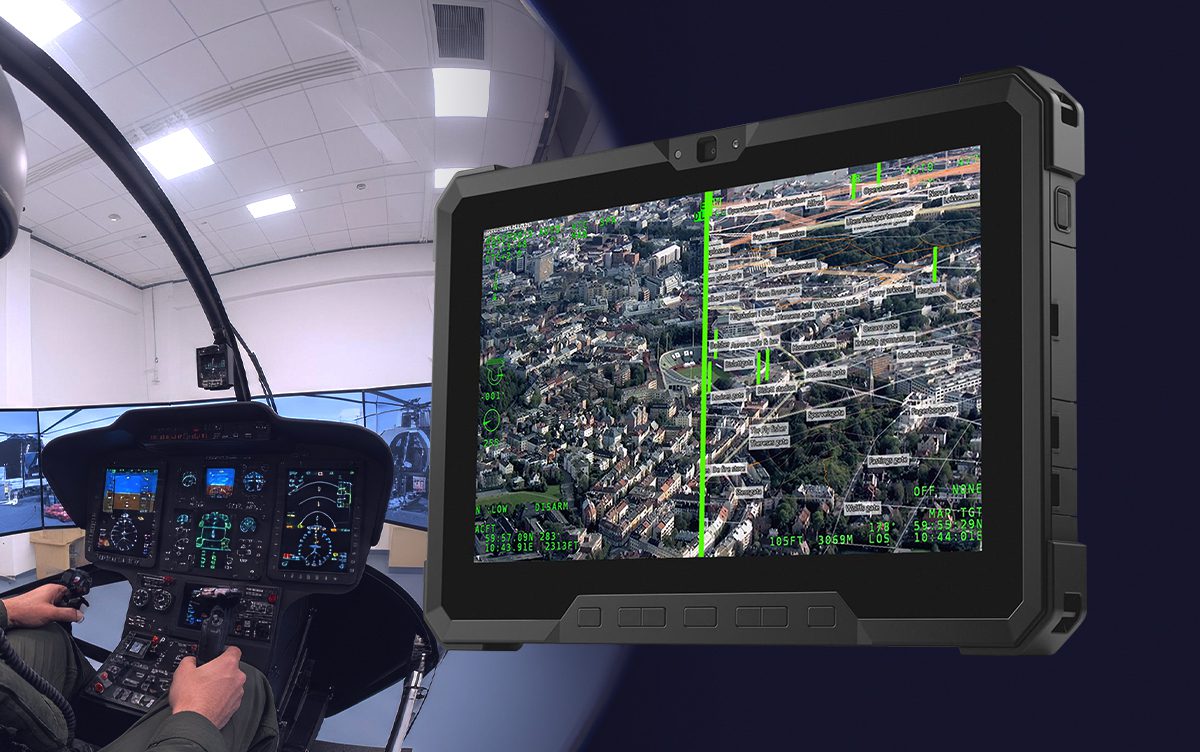
The development of helicopter pilot training technologyhas been largely driven by the introduction of AI and Augmented Reality systems, including FlySight’s OPENSIGHT consoles. The difference with these new technological advancements, though, is that they are applicable both in a simulator and in a ‘real world’ vehicle, allowing a seamless transition from the training arena to operational usage.
Within these systems are specific mission consoles that enhance operator focus, support operations in poor weather or low visibility, and provide pilots with a far greater level of situational awareness. This improves both the safety and effectiveness of each mission, and incorporating these consoles into pilot trainingallows users to transfer their skills from the safety of a simulator to an operational vehicle with ease. The technologies include:
- Augmented Reality – Key to the FlySight OPENSIGHT Mission Consoles is the incorporation of Augmented or Enhanced Reality. By overlaying multiple data layers, AR provides pilots and crews with a far more detailed terrain map, supporting real-time target acquisition and monitoring in appropriate operational contexts. That real-time element is also vital to the success of AR, as it allows continually updated information to be shared between airborne and ground-based operators, leading to far better mission coordination. Enhanced Reality can also provide essential information when terrain has been dramatically altered by natural disasters such as fires, floods, or landslides.
- AI – Artificial intelligence is not the be-all and end-all of mission operations, and it is not likely to replace human operators any time soon. Instead, it should be seen as a valuable tool, especially for processing large amounts of data gathered by onboard multi-spectral sensors.
- Personalized training – The use of AI enables simulators to respond to trainees’ performance, adjusting the level of difficulty to enhance skill sets through more challenging scenarios.
- High-immersion simulations – The biggest challenge with simulation-based pilot trainingis that it must be truly immersive to feel ‘real’. From simulators programmed to realistically pitch and yaw to emulate the sensation of a real aircraft, to mixed-reality cockpit overlays that deliver effective emergency brownout training, modern helicopter pilot training technology creates a far more authentic experience that can be micro-adjusted by simulation operators in real time.
- AI-driven performance assessment and Predictive Analytics – AI enables trainee pilots to undergo extensive performance assessment through systems such as biometric monitoring (e.g., eye movement tracking) and the estimation of key indicators such as cognitive load, reaction times, fatigue, and stress.
VR and AR – uses in the real world
Both Virtual Reality and Augmented or Enhanced Reality are at the very heart of modern helicopter pilot training. The use of this advanced technology enables simulators to feel far more realistic than before, fully immersing trainees to the point that it elevates their ability to respond to real-world scenarios.
Some of these real-world scenarios are difficult to replicate without simulators, primarily due to safety concerns for the pilot and crew. For example, a brownout (loss of visual reference caused by dust, sand, or debris) at 5,000 feet can be a disastrous, dangerous situation that requires calm, considered, and process-correct responses from the pilot. These responses can be practised safely in a simulator without risking lives or expensive machinery.
The ability to train these responses repeatedly not only refines the pilot’s reactions and response time, but effectively reinforces the procedure until it becomes instinctive. Faced with a brownout, engine failure, or systems failure in a real flight, a fully trained pilot will be able to draw on AI-focused training from their simulation practices and respond correctly immediately.
Likewise, operating in poor weather conditions can pose extreme challenges for pilots. AR technology, such as FlySight’s OPENSIGHT anti-haze solution, enables clearer visual references and greater situational awareness. Flying in poor weather conditions can be easily simulated, and the accompanying AI-driven technology helps pilots understand how to tackle this problem.
The future of advanced pilot training
We are already seeing the first autonomous rotary aircraft being tested by the military, and while their general usage is still some years away, the technology is advancing at an exponential rate. Helicopter pilot training over the next five to 10 years will need to consider leaps forward in autonomous vehicles, including drones and now, full-size helicopters, and how manned aircraft interact with these vehicles.
At the cutting edge of these developments are Console Systems and technology such as OPENSIGHT, which can be easily integrated into heritage aircraft and form the foundation of new systems. Easy to understand, intuitive, and integrated into equipment already familiar.
You can find out more about OPENSIGHT’s pilot training support features and real-world applications by exploring our online library of informative guides and video presentations. Alternatively, contact us to find out more by talking to one of our team to find out how FlySight’s OPENSIGHT can elevate your pilot mission to the next level. Call us today.