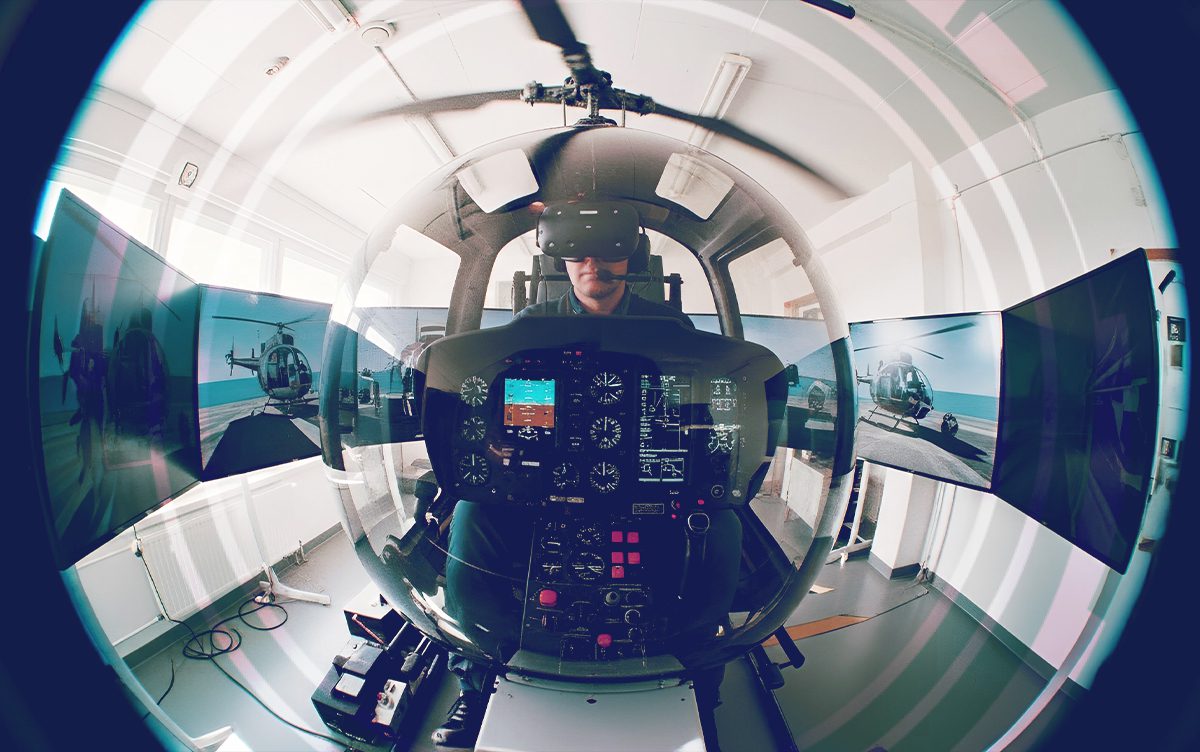
Virtual Reality has significantly advanced traditional flight simulators, making them more realistic, accurate, and immersive. This advancement not only enhances training for both new and experienced pilots but also raises the standards for helicopter pilots in civilian and military operations.
In this article, we’ll take a more in-depth look at mixed reality flight simulators and how they work. We’ll see why VR flight simulators differ from traditional concepts, what benefits they offer, and the future direction these systems might take. We’ll also introduce you to the FlySight system, one of the most advanced AR and VR systems on the market today.
An evolving industry
With the advent of AI and AR, aerospace technology and systems are evolving at an accelerated rate. Platforms are more complex, and human operators must continually expand their skill set to fly the latest aircraft. This requires more advanced training systems and simulators to match the skills required to operate the latest military and civilian aircraft. So, the traditional simulator has to be updated to match the requirements.
VR flight simulators are one of the most effective, adaptable solutions for many aspects of pilot training. Easily updated and customized to any pilot or aircraft, regardless of the operating system, they set a new standard, especially for helicopter crews.
Key uses for MR and VR flight simulators- What mixed reality brings to flight training
Blending virtual reality simulations with traditional hardware cockpit simulators offers significant advantages. By creating an enhanced, more realistic scenario, pilot training is more akin to ‘real life’ and gives trainees a broader understanding of the situations they may face. It also provides a perfect environment for more advanced training, such as emergency-situation simulations and the handling of hostile forces, adverse weather conditions, and high-risk scenarios.
The ability to overlay digital systems and consoles introduces a new, more efficient operational methodology that can be practiced and refined in a simulator before being transferred to a real-world platform, such as a helicopter. Enabling situational training in highly realistic environments while maintaining strict safety protocols results in a more effective training methodology, in which trainees are more likely to absorb information faster and more effectively.
Pilot training and skill development
VR flight training creates a fully immersive visual experience that improves situational awareness and cockpit familiarisation on new platforms, as well as procedural training in startup/shutdown, emergency procedures, and pre-flight checklist processes. Repeating complex manoeuvres and challenging sequences builds procedural ‘muscle memory’, ensuring pilots and crews can instinctively process the procedures when flying. This, in turn, increases reaction time and situational awareness to a much higher level.
Mission‑specific and tactical training
Both military and civilian operators can use mixed-reality flight simulators to develop more effective responses to tactical scenarios, fine-tuning mission protocols in the air and on the ground. This can also apply to emergency responses for helicopter units, including SAR operations, rescues at sea, and operating in natural disaster zones such as wildfires. The combination of real controls and virtual visuals makes VR flight simulators ideal and creates a sense of tactical realism.
Hazardous or hard to reproduce scenarios
Mixed reality flight simulators make it easy and above all, safe, for practicing situations that would be impossible to recreate using other methods, including:
- Engine failure
- Encountering severe weather
- Low or zero-visibility landings or landings on unstable platforms such as aircraft carriers
- Night operations
- Operation in hostile combat zones
- Major system malfunctions
Cost-effective training and resource optimisation
Training pilots and crews is both expensive and time-consuming, especially for complex platforms like helicopters. These crews require ongoing development and best-practice training on advanced systems, including flight consoles and AI- or Enhanced Reality mission technologies. The core benefit of mixed reality flight simulators is that they deliver the most time- and cost-efficient training to operators. Their modular, upgradable, and scalable design reduces operating costs, enables system customisation, and allows more pilots to train on the same platform as new technologies emerge.
Why aviation training requires more advanced training
The days when the skies were relatively empty are long gone. Today, the increasing amount of air traffic means that pilots, especially those working in congested areas around busy flight paths and urban areas, need to be at the top of their game to cope with the additional stresses of piloting modern aircraft in a busy environment. Situational awareness is key, and continued aviation training can improve that immeasurably.
Advanced aviation training is essential because aviation technology has rapidly evolved. Modern cockpits, particularly in helicopters, feature Enhanced Reality consoles, heads-up displays, and sophisticated mission systems. Pilots and crews must continuously update their skills to master these technologies and operational techniques.
The need for faster, safer training environments enables the development of advanced training programs that make pilots better, safer, and more adept at coping with high-pressure situations as they arise.
Real-world flight scenarios enhanced through AR and VR
There are plenty of real-world flight scenarios that can be brought into a VR flight simulator for pilot training. These can include:
Mid-air emergencies – Having the muscle memory to immediately implement the correct course of action can increase the safety of both the aircraft and the crew. Practicing this repeatedly means reactions are automatic and faster, leading to better outcomes.
Crisis decision-making – VR flight training moves pilots, especially novice pilots, beyond the ‘freeze’ response when confronted with a crisis, ensuring they make the right decisions faster and more accurately.
Bad weather and crosswind landings – Adverse weather is always a challenge to fly in, especially for fixed-wing aircraft and helicopters. Practicing adverse-weather landings in a virtual reality flight simulator gives pilots the chance to hone their skills in the safety of a simulator before transferring those skills to real-world situations. This is particularly relevant when dealing with crosswinds, as the ground effect created by helicopters can make the situation challenging and dangerous.
Combat situations – For military crews, the ability to train in a virtual reality flight simulator ensures that, when operating in a hostile area or combat zone, their decision-making is fine-tuned and more accurate.
SAR procedures – Whether on land or at sea, search and rescue procedures must be expertly executed, as lives depend on the smooth operational procedures of crews and pilots. This is particularly true when dealing with a combination of challenging terrain and bad weather.
The impact of MR and VR flight simulations on crew resource management
MR and VR are reshaping crew resource management by improving communication, teamwork, situational awareness, and decision‑making. The immersive nature of VR and mixed-reality simulators enables crews to understand concepts, applications, and human-machine interactions.
Virtual reality flight simulators can also enhance crews’ awareness of how the aircraft operates, as well as their ability to track environmental cues and coordinate their actions in highly pressurised situations.
How can MR and VR complement traditional full-motion simulators?
Mixed reality simulators combine both old and new technology to create the ultimate flight training experience.
As well as introducing new concepts such as FlySight’s innovative OPENSIGHT Mission Console and other turnkey solutions, a combination of VR flight simulators that also incorporate “old school” full-motion sensors gives trainees a fully immersive experience. It effectively offers them the “best of both worlds” in flight training.
There are, of courese, some challenges to deal with when it comes to mixed reality flight simulatore. Crew may find that the simulator’s immersive nature can lead to debilitating bouts of motion sickness, even in experienced pilots. However, this is just a temporary issue and can eventually by overcome with well-documented techniques.
Other issue include hardware and upgrade costs. These can be reduced by opting for modular systems within a training simulator that can be added as required and when budgetary restraints allow.
How will MR and VR shape the future of aerospace?
While virtual reality flight simulators are ideal for training human operators, the rise of unmanned systems will create a new requirement for training operators to integrate with UAVs, such as drones. MR and VR may become more prevalent in training for ground-based operators and aircraft teams.
Training could also extend to those charged with maintaining vehicles, offering an immersive insight into, for example, wiring looms that are normally inaccessible without a time-consuming and costly servicing process.
The introduction of turnkey solutions that are customised for individual operators is becoming more common, especially with the development of systems such as FlySight’s OPENSIGHT VR solutions and mission consoles. Intuitive systems that use both familiar hardware and advanced aviation-enhanced reality overlays are easily integrated into mixed-reality flight simulators, creating the ultimate training scenario for aircraft operators.
You can find out more about FlySight’s VR solutions for vertical flight by browsing the information available on our OPENSIGHT solutions page. Or get in touch with our team to find out how FlySight’s OPENSIGHT can work both in simulators and in the real world. Call us today.