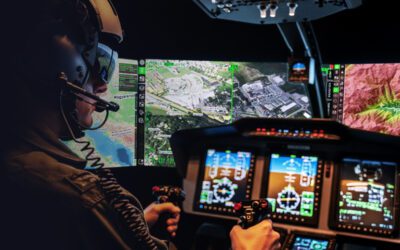
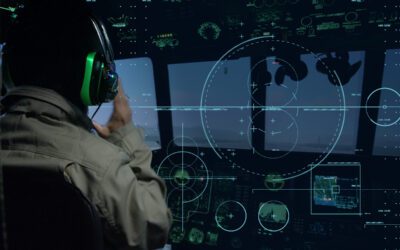
Modern military aviation is no longer about a single aircraft completing a single task. Instead, it involves highly complex, interconnected, multi‑domain, and data‑driven mission chains that rely heavily on advanced avionics systems. These chains have grown dramatically more complicated in recent years due to technological, operational, and strategic factors. Decision-making in aviation relies on clear communication between operators, ground personnel, and analysts. Without a defined mission chain, a successful outcome is impossible.
FlySight’s OPENSIGHT system has significantly enhanced modern mission chains by introducing new processes. These embrace the latest in Enhanced Reality and Artificial Intelligence, rather than eliminating existing processes. In this article, we examine decision-making in aviation. We will show how technology can enhance this process at critical points.
From surveillance and intelligence gathering to analysis and decision-making, we’ll also examine the challenges of turning raw data into clear, actionable insights and, ultimately, into operational actions. We’ll also introduce you to the feature-rich OPENSIGHT console system and explain how it plays a key role as an aviation decision-support tool, particularly applicable to helicopter-based operational platforms.
The need for a clear mission chain
It is possible to have an overabundance of intelligence. While mission decision-making relies on information gathered before an operational plan is put into place, you need to know that your mission chain is working with the right information to start with. Growing data volumes, especially when gathered from multiple sources, need to be cohesive to be effective. It also needs to be analysed quickly and effectively to filter out superfluous information that can obscure mission-critical data.
The modern military is also far more dispersed and fragmented, so a mission chain must account for the organisation’s complexity to avoid negative impacts on mission continuity. Information from reconnaissance teams, satellite imagery, unmanned drones, and more needs to be cohesively combined and assessed to allow mission commanders to make decisions that maximise the effective use of teams and equipment.
This is particularly important regarding helicopter platforms, which are complex operational systems. Crews rely on clearly defined mission parameters derived from selective intelligence-gathering processes, as well as onboard systems that help filter and refine real-time information. Utilising aviation decision support tools, such as OPENSIGHT’s Mission Console, is the modern way to achieve this, ensuring crew and aircraft safety and a more streamlined mission chain from the ground up.
How can technology enhance decision-making support during critical aviation missions?
Technology has become a force multiplier for decision‑making in critical aviation missions. When the stakes are high and time is short, the right tools can compress timelines, reduce cognitive load, increase situational awareness, and ultimately, improve mission outcomes.
Traditionally, decision-making support systems were human-based. While the input of a human operator is essential (even with modern AI and ER systems), the sheer volume of data gathered needs to be sifted to reach the right decision quickly.
FlySight’s OPENSIGHT represents the cutting edge of aviation decision-making support systems by creating a bespoke mission console that integrates AI and Enhanced Reality into legacy systems. The result is a vastly improved ability by operators and ground crew to assess information quickly and apply the relevant data to the mission chain.
OPENSIGHT has been developed for use in helicopter aviation but can also be integrated into other operational systems, including marine craft and fixed-wing aircraft. In this context, we’re looking specifically at its role in helicopter aviation, and it’s here that OPENSIGHT really comes into its own.
What is OPENSIGHT?
OPENSIGHT was developed by FlySight as a key decision-making support system for aviation, allowing crew to access multi-layered data that uses both Enhanced Reality options and Artificial Intelligence as effective tools. It’s modular in nature – a system increasingly adopted by military and security forces around the world for its ability to create a turnkey solution for everything from reconnaissance work to active combat missions.
Utilising AI and ER, OPENSIGHT allows faster interpretation of complex data, including weather conditions and both urban and open terrain. It also provides predictive analytics to anticipate hazards and system failures, enhancing the safety and well-being of both the crew and the aircraft.
While it would never be in a position to completely ‘take over’ aviation decision-making from human operators, a system like OPENSIGHT can alleviate the workload placed on pilots and crew, allowing them to focus on operational systems and the mission itself. OPENSIGHT effectively streamlines the mission chain with intuitive, easy-to-adopt technology that integrates seamlessly with legacy systems operators are already familiar with.
Features of OPENSIGHT that help with mission decision-making
OPENSIGHT is a feature-rich system that can be customised to suit the user’s needs. Incorporating a base console that can accommodate additional turnkey bolt-ons, its multi-layered construction makes it a powerful tool for decision-making support in aviation, particularly in helicopter operations. The mission chain is enhanced by a range of features, which include:
- Real-time data analysis – This is the single-most important element of any mission chain. Data can be quickly gathered using multispectral cameras, uploaded to secure ground or cloud-based systems, and relayed back to a command post, where it can be analysed by both AI and human operators. AI filters out background ‘noise’ to give a clearer, less cluttered dataset, while human operators assess this information and filter it back into the mission chain. The mission decision can be achieved quickly, and new instructions can then be relayed back to the crew if necessary.
- Use of sensors to map the environment and improve situational awareness – The OPENSIGHT console integrates data from a wide range of onboard and external senses and can develop multi-layered maps of environments, even those altered by combat activities, earthquakes, or other natural disasters. Creating maps augmented with Enhanced Reality means additional information is instantly available to the crew and to those monitoring the operation further along the mission chain. This interlinked mapping can also draw on other datasets, such as satellite imagery, and can be used for the detection and identification of targets.
- 3D visual displays for flight operators – Navigation and obstacle data standards such as DVOF and ARINC-424 can be used as inputs to 3D visualisation and mapping systems that include a wealth of information, from flight height levels in urban areas to waypoints, visual markers, and restricted flight zones.
This information can be rendered and overlaid onto 3D visual displays for flight operators, both in the cockpit and for mission controllers on the ground, in real time, accounting for the fluid nature of hostile zones. The creation of augmented reality mapping provides everyone in the mission chain, including flight operators, with a real-time shared overview of the situation, leading to greater situational awareness and better aviation decision-making. OPENSIGHT’s mission console represents a sophisticated Augmented Reality engine for real-time vector overlay superimposition.
- Video processing algorithms for image enhancement – Algorithms exist within the console and modular add-ons that can enhance the images captured by any video streaming. This includes dehazing technology that can give flight operators a clear, fog-free view of the terrain even when it’s obscured by fog or hazy conditions.
- Interoperability between OPENSIGHT and other flight systems – One of OPENSIGHT’s strongest USPs as an aviation decision-support tool is its interoperability with the console and other flight systems, including legacy systems. This makes it a particularly useful tool when multiple operators are working on joint missions, enabling clear, cohesive information exchange between units in the air and on the ground. This creates a far more streamlined mission chain, even across international borders.
- Automatic target recognition – OPENSIGHT has a distinct advantage over competitors due to its ATR capability, which helps aviators identify ground targets, including moving targets. OPENSIGHT’s ATR system is particularly useful in complex urban settings, as it can ‘lock on’ to a target, detecting, classifying, and identifying it in real time.
The challenges of turning raw edge data into actionable insights
While AI and Enhanced Reality may seem like a huge leap forward in decision-making support in aviation, the field still faces some challenges. The most common of these include data overload and a loss of context during handover, where there is literally too much information available to the mission chain. This can effectively ‘muddy the water’ and delay the mission decision-making process.
Mission commanders and operators need clearly defined, actionable intelligence. OPENSIGHT’s AI component can help filter out background noise, ensuring the information relayed to helicopter operators is relevant to their immediate situation. OPENSIGHT’s capabilities and strengths are designed to overcome these issues by providing unified data processing, sensor fusion from multiple sources (including external sources), a shared operational picture to multinational forces, and AR and VR support.
While AI is not yet the ‘fix-all’ solution for decision-making support in aviation, it does play a major role, particularly in analytics. AI within the context of a system like OPENSIGHT enables enhanced processes, such as target detection, predictive analysis, and behaviour and pattern recognition, which are especially useful for analysing topics such as crowd dynamics.
These capabilities are not just suited for military mission chains but can also be applied to a variety of other aviation uses, including border surveillance, disaster response, SAR, and law enforcement helicopter operations. In fact, OPENSIGHT and Enhanced Reality systems in general are set to play a major role in developing more modern approaches to mission chain management in the future.