Technology never stands still, especially in avionics. In response to the continuous forward momentum and advancements in on-board and ground-based tech, pilot training has to keep pace. In the last 10 to 20 years, the advent of new technologies such as Augmented Reality and, of course, AI has led to leaps in the effectiveness and versatility of avionics systems and pilot interfaces that are considerably greater than in previous decades, when the majority of advances were mechanical. In response, helicopter pilot training has become more complex. The result is that helicopter flight training has to be an ongoing process.
In this article, we’ll take an in-depth look at how augmented reality simulations could herald a new era in the future of helicopter pilot training. We’ll examine which training options are now available and which helicopter pilot training technologies are leading the way in developing more advanced training techniques that don’t rely on real-time flight hours and can be carried out within the safety of a ground-based simulator.
The development of ‘smart training’ is revolutionising how pilots learn, so we’ll go into detail on how augmented reality is helping to produce pilots who feel increasingly comfortable working alongside AI-assisted systems in aircraft. We’ll also show you how FlySight’s OPENSIGHT system is at the forefront of modern helicopter flight training technology and real-world operational systems.
The current state of helicopter flight training and the challenges in the industry
Immersive environments such as high-tech simulators have been a key part of helicopter pilot training for years. Safer, highly effective and often more cost-efficient over time, simulation training creates an immersive situation that emulates real-world flight patterns, testing trainee pilots to their limits without putting them at risk.
The introduction of augmented or enhanced reality technology has been a natural merging of legacy technology and new advancements, enriching immersive simulation training to a whole new level. The issue, though, is that simulation time is valuable and in high demand. The other factor is the sheer pace of advancement and the increasing demands placed on pilots and crews.
Continual pilot training is as much a part of life for experienced pilots as it is for new recruits in both civilian and military roles. The rising levels of complexity mean that pilots can struggle to keep up with advancements, leading to more time spent in flight simulators familiarising themselves with additional systems or upgrades to their current operating systems, as well as upgrades, best practices, and new safety protocols.
This has a knock-on effect, limiting the number of live flight hours. A balance has to be achieved so that pilot training delivers the right expertise and training methods within a manageable timeframe, without compromising safety or standards. This is where augmented reality can help.
New and emerging helicopter pilot training technologies
Traditional helicopter pilot training focused on classroom instruction and one-to-one instructor training, and earlier simulators were more limited in their capacity. However, as simulators became more advanced, the classroom time became less, and focus shifted to ‘hands-on’ training methodology in simulators.
Fast-forward to the advent of enhanced reality and AI-powered functionality, and you suddenly have fully immersive helicopter pilot training technology that offers a far more comprehensive teaching tool. Today’s AI-powered tools include:
- AI-powered Adaptive Training Systems – Practising the same scenario in a simulator over and over again may be great for developing muscle memory, but it doesn’t emulate real-world conditions. AI-powered Adaptive Training Systems (ATS) respond to how the student is progressing through the simulation and change it to present new challenges. For example, it may increase the wind speed or reduce visibility to simulate worsening weather conditions or introduce hostile fire from an unexpected direction in a battlefield simulation.
- Digital Twin Technology – Creating a realistic cockpit environment is relatively straightforward mechanically; a true ‘digital twin’ extends this with synchronized data and system modelling. AI and enhanced reality excel is in creating a synchronised virtual model that reflects real‑time experiences. This allows pilots to train in various scenarios, including engine and rotor system responses, failure modes, and emergency procedures.
- Motion-based Hybrid Simulators – Sitting in a static simulator won’t provide a trainee pilot with a true representation of a possible scenario. Physical inputs, such as increased vibrations from a malfunctioning rotor or buffeting from a sudden crosswind in an urban environment, reinforce procedural memory. When replicated via motion-based hybrid simulators, the pilot receives an extra dimension to the training environment, making it far more realistic.
- Biometric Performance Monitoring – This includes gathering pilot input and performance metrics, creating realistic environmental conditions, and assessing the pilot’s reactions to them. It can also be used to help indicate operator fatigue, giving teams a much clearer understanding of the pilot’s ability to process data and react accordingly over a longer period.
Augmented reality simulation in helicopter training
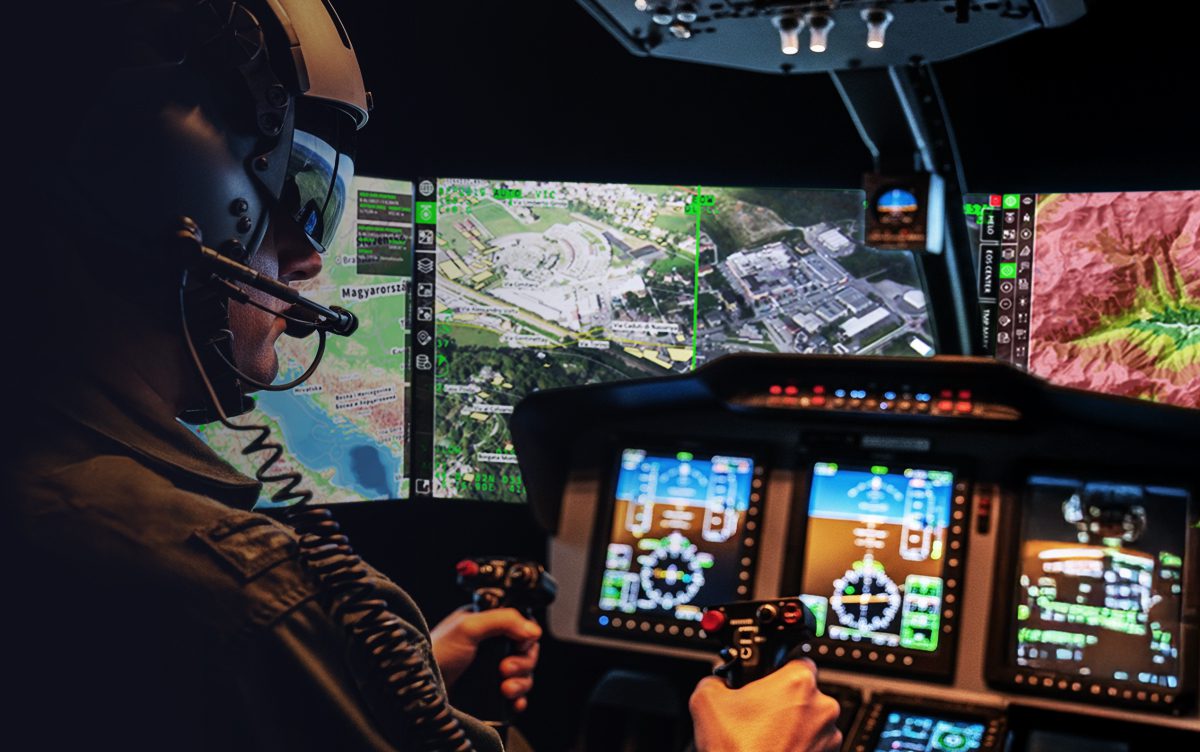
Augmented reality and VR are introducing a whole new level of immersive experiences for helicopter pilot training. Its ability to simulate a highly authentic cockpit environment with 360° visual representation ensures trainees experience the full range of scenarios within the safety of a ground-based unit. Adaptive training means that AR and VR simulations can keep pace with the trainee’s learning curve, introducing more challenging scenarios as the trainee progresses.
Examples include AR headsets and smart visors that fully immerse the trainee in the scenario, without external distractions that could limit the viability of a training session. AR hardware and software combinations can also include 360° simulators that put the trainee right in the centre of a highly realistic environment, complete with realistic control panels, visual stimuli, sounds, and even physical stimuli such as excessive vibrations or tilt and yaw input.
Mixed-reality AR can offer advantages over a VR simulation in certain training scenarios, as it feels more ‘real’ and doesn’t rely on purely VR creation, which may have limitations in terms of authenticity.
The key benefits of augmented reality for helicopter pilot training
The major benefits of AR for helicopter pilot training are many and varied, ranging from greater security during training in high-risk scenarios to a better understanding of emergency procedures without putting the trainee at undue risk.
- More complex environments – AR enables programmers to create multi-layer systems that include terrain overlays and real-time weather simulation.
- Safer emergency scenario training – Extreme situations such as engine failure, brownout or whiteout landings, and rotor malfunctions can be rehearsed as many times as needed without endangering the pilot, crew, or a (very expensive) aircraft. Biometric analysis can also help trainees understand how to maintain a calm, focused approach to emergencies, creating the ‘muscle memory’ we mentioned earlier.
- Reduced training costs – Augmented Reality and VR helicopter-pilot training technology offer other advantages. Ground-based simulation training means lower fuel consumption, reduced aircraft damage, longer aircraft lifespan, and improved safety for operators and support teams.
- Improved knowledge retention – Repeated training in a realistic, fully immersive environment reinforces muscle memory, provides real-time performance feedback, and offers a more realistic flight experience.
How can advanced helicopter training technology improve safety and regulatory compliance?
The more highly trained a helicopter pilot is, the better their performance, and this is reflected in natural improvements in safety and regulatory compliance. Better training can contribute to reduced accident risk, as the pilot and crew are better able to prepare for multiple scenarios and respond accordingly. Better helicopter pilot training also means a lower risk of mental fatigue, which can lead to judgment errors that ultimately put the vehicle and crew at greater risk.
Higher-level training enables instructors to reassess pilot competency, including their ability to respond to high-pressure situations. It also enables new pilots to log more training hours before moving on to live flights. This can shorten the amount of time required for real-world training, reducing pilot training costs and making the most effective use of both human and mechanical resources.
Challenges of advanced technology
Advanced helicopter pilot training technology may sound like a magic bullet when it comes to cost, time, and other factors, but it also has some challenges to overcome. Technology such as AR in helicopter pilot training requires that the latest technology can be integrated with existing legacy simulators. There are also costs for upgraded hardware, and potential delays in approval timelines for bringing new technology into service.
What next? – Future trends beyond 2026
The pace of helicopter flight training technology’s evolution is extraordinary. The advent of AR and VR simulations already provides high levels of value to training scenarios. As we push forward with new and more exciting technological advances, expect to see truly immersive training experiences where it’s difficult to tell what’s real and what’s artificial. Mixed-reality cockpits will provide far more technological support to crews and pilots, reducing fatigue and improving reaction times. Remote instructor-led AR sessions and a cloud-based global training ecosystem between flight operator teams will truly take helicopter training to a whole new level, both in civilian and military aviation.
At the forefront of this advancement is FlySight’s revolutionary modular system, OPENSIGHT. This platform embraces AR features and integrates them into a real-world environment, where they work alongside human crews and pilots. The aim with OPENSIGHT is to augment rather than ‘replace’, enhancing everything from visual observation to the integration of real-time 3D data with augmented visualisations. OPENSIGHT Enhanced Reality System products introduce advanced video processing, encoding, and decoding capabilities that can provide greater visual input even in challenging conditions. As OPENSIGHT can be integrated into simulators and operational aircraft, it can provide a smoother transition for users from training to real-world operations.
You can find out more about OPENSIGHT’s Enhanced Reality System by browsing the informative page on our website. You can also read more in our in-depth blog that looks at the future of AR training technologies. Or get in touch directly to discover more on OPENSIGHT’s Augmented Reality Simulation training features and how they could help you take your helicopter pilot training and operations to the next level.