Artificial Intelligence is a rapidly evolving technology and has, in a few short years, permeated almost every aspect of modern life. Its ability to process huge amounts of data makes it a natural fit for military, law enforcement, border control, and many other applications, making AI surveillance a force to be reckoned with in the modern age. Artificial Intelligence surveillance is a fast‑evolving field, with applications such as object tracking, motion analysis, and automated monitoring of crowds, traffic systems, and more.
In this article, we’ll take a more in-depth look at AI in security and surveillance, its applications, and the current technologies available to users. We will examine how it’s used across industries, the military, and, in particular, law enforcement, as well as how it’s incorporated into airborne units such as helicopters and drones. We’ll see what the core components of AI surveillance are, and how systems such as FlySight’s OPENSIGHT Mission Console use AI within the context of heritage technology and modern challenges.
How can AI technology improve surveillance capabilities?
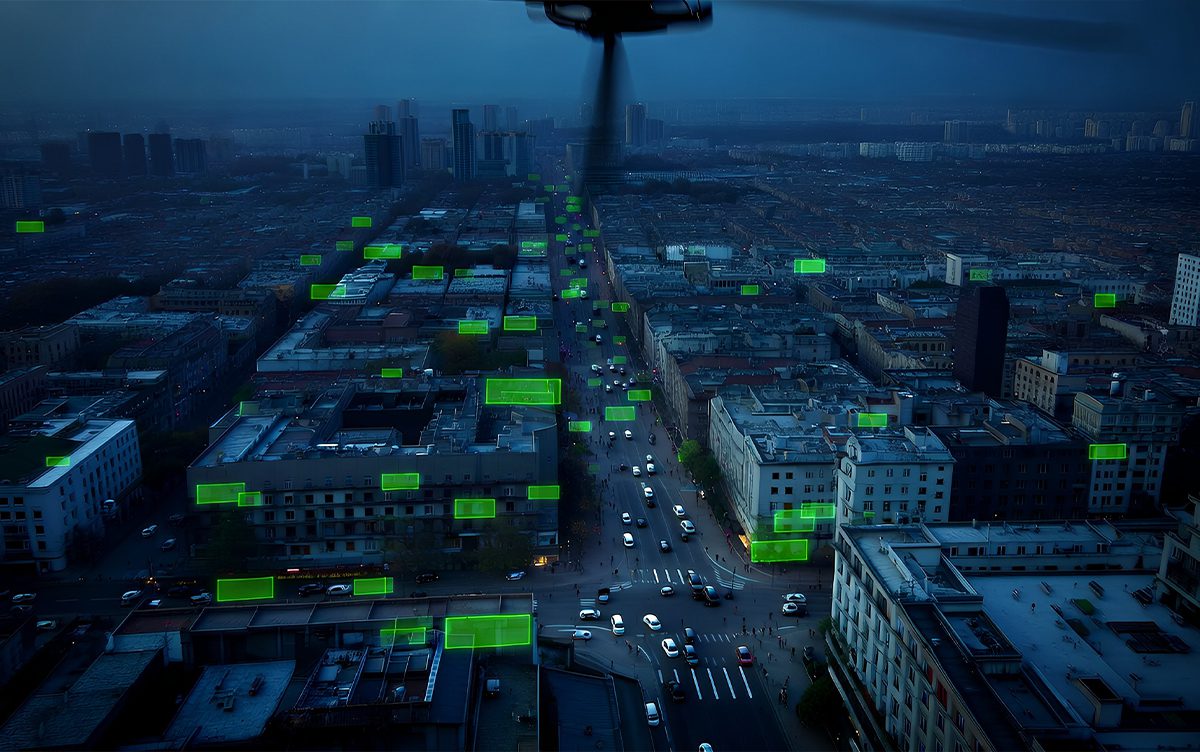
The key advantage that AI in security and surveillance offers is its ability to process large amounts of data very quickly. This makes its use for target location invaluable, as it can sift relevant data from the ‘background noise’ using complex algorithms in real time, allowing observers to track targets, even in complex urban environments or challenging terrain.
Enhanced real‑time monitoring means that AI analyses resources such as video frame‑by‑frame, reducing reliance on human operators. However, it must be said right from the start that human operators must be part of the analysis process, as it would be misguided to rely solely on sources such as AI surveillance camera data without the knowledge and experience of a human observer to correlate the findings.
As AI surveillance becomes more advanced, it can deliver predictive results and real-time data streams.
Predictive surveillance examines parameters such as crowd dynamics and behavioural patterns to generate predictive analytics that enable earlier intervention and better risk mitigation. It does this by looking for movement anomalies and behaviour patterns that may indicate elevated risk.
This is particularly important in crowd surveillance, where aerial units such as helicopters can observe crowd reactions to identify potential flash points or areas where public safety may be at risk due to terrain. This data can be quickly analysed by AI and human operators and distributed to ground forces in real time to safely control a crowd. It also provides aerial operators with enhanced situational awareness, ensuring the safety of the unit and its operators in extremely fluid situations.
In addition to predictive analytics and quicker, more accurate decision-making, both on the ground and in the air, AI surveillance technology offers many other advantages. AI’s ability to sift through data and filter out the vast majority of irrelevant information (the so-called ‘background noise’) means that the information presented to human operators is more focused and better aligned with mission parameters. This can help to reduce the risk of certain mistakes, such as misidentifying a target or drawing incorrect conclusions from limited or unclear data streams.
Consequently, the inclusion of AI surveillance within an active command structure increases the chances of mission success, especially in hostile or challenging situations where accuracy is key. The speed with which information can be shared between airborne teams and ground-based command centres means that orders can be changed based on the very latest intelligence gathered, assessed, and acted on in real time.
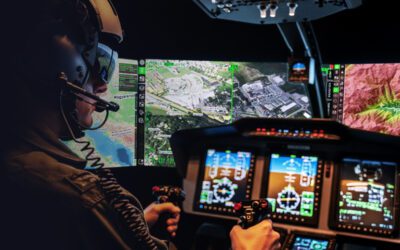
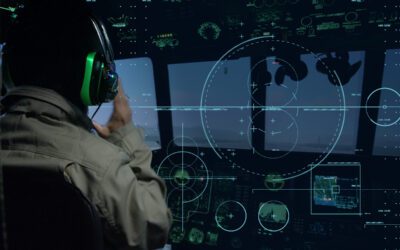
When used effectively, artificial intelligence surveillance can play a key role in reducing the workload of human operators. By working ‘in the background’, AI allows operators and pilots to focus on other operational processes. For example, Detection, Classification, and Identification tools can locate and track a target, providing the pilot with detailed, near-continuous information via a heads-up display, while the pilot focuses on situational awareness and navigating the terrain as safely as possible.
It can even enable the pilot to move the vehicle out of visual range to avoid detection, thus maintaining the element of surprise should a ground operation be required to apprehend a dangerous target. This can go a long way toward minimizing the risk to innocent civilians in the area and efficiently guiding ground units to close in on the target.
Where does AI surveillance belong?
Artificial intelligence surveillance has a role to play in both military and civilian theatres, law enforcement, and even environmental monitoring. That is one of the major advantages of artificial intelligence in surveillance– its flexibility and adaptability.
- Military – AI surveillance can be integrated into both manned and unmanned aerial platforms, providing up-to-the-minute information in hostile areas and playing a major role in mission management. Onboard helicopters, AI surveillance cameras can get on with assessing terrain, identifying targets, and gathering vital data while the pilot focuses on flying the aircraft. This reduces human fatigue and is essential to the safe operation of aerial units in hostile territory.
Onboard drones, AI surveillance cameras can feed data directly back to the operator at mission command, allowing instant analysis and target identification in often highly fluid situations.
- Law Enforcement – Artificial intelligence can be extremely beneficial for law enforcement aerial units. The algorithms can use active data to analyse crowd dynamics and locate moving targets, including vehicles. Cameras are now so advanced that they can identify vehicle licence plates and maintain target tracking where conditions allow, ignoring other similar vehicles and minimizing background distractions.
- Border control – Borders, especially those that are disputed, can become flashpoints for unrest. Regular analysis of any unusual activity on either side of a border can be conducted by AI surveillance cameras and compared with previous data. In turn, this can identify unusual activity patterns that may indicate a potential incursion. AI can also look for regularly used, unofficial tracks across borders that may indicate the activities of smugglers or people-trafficking operations.
- Traffic monitoring – AI surveillance is ideally suited for traffic monitoring, offering tools such as real-time vehicle detection and classification, multi-object tracking, traffic pattern analysis to enable adaptive traffic management, and incident detection, resulting in faster emergency response times.
- Disaster response – In remote areas, managing a major incident such as a wildfire can be extremely difficult. AI surveillance can be used via aerial units, such as helicopters and unmanned drones, to gather information on potential ‘hot spots’ and the projected direction and path of a fire by collating data from multisensory cameras.
Core AI technologies used in aerial surveillance
Deep Learning is at the heart of AI surveillance, enabling AI surveillance systems on manned aircraft and drones to “see” and interpret the world. DL includes learning from object detection and classification, semantic segmentation (mapping terrain, roads, vegetation, and hazards), and multi‑object tracking. This information is then distributed either to the Cloud for relay back to mission control units or using Edge AI Processing to analyse the data onboard the aircraft and provide the operators with real-time data.
- Object detection – Detecting, classifying, and identifying a target are part of turnkey solutions that incorporate AI systems such as FlySight’s OPENSIGHT Mission Console.
- Pattern Recognition – While this is an important role for autonomous units, for mission protocol, a human operator must still be involved in the final analysis of the data.
- Movement tracking – Even in challenging urban environments, movement tracking plays a crucial role in surveillance operations. OPENSIGHT’s ability to lock on to and track a target, while ignoring all similar data, makes it a highly tuned system that’s extremely effective in real-time operations.
- Predictive movement – Building on the movement-tracking capabilities of AI surveillance technology, predictive movement can put operational units one step ahead of their target by analysing terrain and predicting the most likely route the target will take.
The ethical and political challenges of AI use for surveillance
While the technology behind AI surveillancecontinues to advance, the ethical arguments remain a concern for many. The primary worry is how data is collected, used and stored, despite the implementation of data protection laws around the world. Often, this data is collected without consent, and the need for transparency in data collection, storage, and use remains unaddressed.
In some parts of the world, this has implications for civil liberties and human rights, making monitoring the collection and use of AI surveillance data even more important. Once deployed, surveillance systems can often suffer from ‘surveillance creep’ where they move beyond the parameters of their original mandate. This can raise questions about the political motivation behind such data collection and whether it’s being used legitimately or to control the population.
Ultimately, though, many of these concerns can be addressed by users of AI surveillance being as transparent as possible (taking into account matters of national security or military operations). AI surveillance is increasingly visible and widely discussed. What operators have to do is demonstrate that it is being used legitimately and that it is not operating autonomously – the biggest concern that many people have regarding AI surveillance technology.
FlySight OPENSIGHT – The AI platform for helicopter operations
At the cutting edge of AI surveillance technology is FlySight’s OPENSIGHT Mission Console. This turnkey solution creates integrated mission consoles that include key features, including target recognition, situational awareness, and visual enhancements such as dehazing tool.
Tools such as a Map Creator can process raw geospatial data into optimized 3D maps, while other features, such as the NATO STANAG 4607 Ground Target Tracking Enhancement, make it much easier to identify and track targets.
OPENSIGHT’s AI systems can integrate with stand-alone systems, such as the NATO STANAG 7023 Imagery Decoder, allowing operators to instantly access and decipher relevant NATO-standard imagery.
With a bespoke approach to creating mission consoles for helicopters and other aerial units, including swarm drones and autonomous craft, OPENSIGHT is providing operators with the very latest technology for a wide range of mission parameters.
You can find out more about OPENSIGHT’s aerial surveillance capabilities by browsing the comprehensive resources library on our OPENSIGHT page. Alternatively, get in touch with our team and discuss your AI surveillanceneeds in confidence with one of our experts today.