Surveillance technology has gone from passive systems featuring a security guard and a bank of CCTV monitors in the 1980s and ‘90s to far more active systems today. The key instigator in the shift in video surveillance has been the introduction of AI. Artificial intelligence for video surveillance opens up a whole new raft of possibilities, providing operators with a much more interactive system that can assess rather than simply observe.
In this article, we are going to take an in-depth look at how AI surveillance systems are changing the face of video surveillance, both on the ground and in the air. We’ll examine the features of Edge AI-assisted surveillance cameras, investigate how these systems work, and discuss their key applications. We’ll also talk about how these AI surveillance systems can be integrated into other operational set-ups, including mission console platforms such as FlySight’s innovative OPENSIGHT Mission Console system.
How is AI changing video surveillance capabilities in various sectors?
AI is reshaping video surveillance across every major sector by turning cameras from passive recorders into real‑time, decision‑making systems. Rather than simply recording grainy images that show only part of the scenario and are easily overlooked by a human operator, AI video surveillance looks for other aspects, such as behavioural patterns and environmental changes that can indicate a threat.
This enables faster responses, flagging up indicators via complex algorithms and initiating reactions from human operators much more quickly. AI surveillance isn’t a replacement for human monitoring, but it is an extremely useful tool in surveillance teams’ arsenals. For example, in the retail sector, AI surveillance can identify behavioural ‘markers’ such as concealing items, ‘shelf-sweeping’ or circling. An alert can then be sent to staff to move to that particular area of the store to monitor the situation in person.
In the healthcare sector, AI surveillance is increasingly used in hospitals and care homes to detect patients who fall or are unstable, and to monitor vulnerable patients more effectively and continuously, without distractions. For institutions that struggle with staffing, AI surveillance isn’t just a useful tool; it can help improve patient safety and reassure them that their well-being is taken seriously 24/7.
In law enforcement, active surveillance can often be challenging, especially from airborne platforms. This is primarily due to the level of background ‘noise’ that most surveillance systems pick up, and also identifying and monitoring a single target can be difficult to achieve and maintain.
AI video surveillance can effectively filter out excess background noise and erroneous data, as well as maintain target tracking more effectively, making it easier for operators to stay focused on a single target and predict its movement patterns.
The evolution of video surveillance
The days of security guards and banks of CCTV cameras passively recording are not over. What has changed is how data from cameras is gathered and processed, and the level of assistance AI can provide to human users in almost any surveillance scenario.
One of the biggest problems with traditional video surveillance is that it is all too easy for a human operator to miss a vital piece of information picked up by the cameras. This is particularly true when a single operator is faced with a bank of monitors, as in most standard surveillance operations. Scanning from one monitor to another means the operator is only receiving a fraction of the information gathered by the cameras.
What AI surveillance systems do is take over the difficult task of analysing video feeds continuously and at scale, turning passive recording into active, real-time prevention. It does this using a variety of different technologies.
- Sensors for object tracking –Tracking sensors can be linked to AI surveillance systems that immediately alert if an item is moved beyond a certain point.
- Assisted decision-making – While the final decision will always rest with human operators, AI surveillance plays a crucial role in the decision-making process. It’s designed to apply consistent analytical criteria, rather than make assumptions. AI takes the ‘gut feeling’ approach to surveillance out of the equation, focusing on evidence and, in some situations, predictive algorithms.
- Predictive targeting and movement patterns – The ability to estimate likely movement trajectories is a unique feature of AI video surveillance. Predictive analytics can also be integrated into other surveillance systems, such as traffic monitoring. For example, AI can use stored data to predict when a junction with traffic lights is likely to be particularly busy (such as during certain times of day). In response, it can adjust light sequences to improve vehicle flow, easing traffic congestion.
Edge AI-assisted surveillance cameras
While many AI surveillance systems work in tandem with cameras and video recording units, Edge AI-assisted surveillance uses cameras that run AI directly on the device itself, and not via the Cloud or other storage or connection solutions. Because AI is incorporated into the camera, it can analyse data in real time.
The biggest benefit of Edge AI-assisted cameras is that decisions can be made instantly, considering not just the visual images collected by the camera but also behavioural analysis, anomaly detection, and object detection. The camera can then send real-time alerts, trigger or interface with other systems in the network, and track across multiple viewpoints.
The other major advantage of this system is that it operates on a low bandwidth, sending short clips or compressed data packets rather than continuous streams that can slow the overall system down to a crawl.
How does AI track targets?
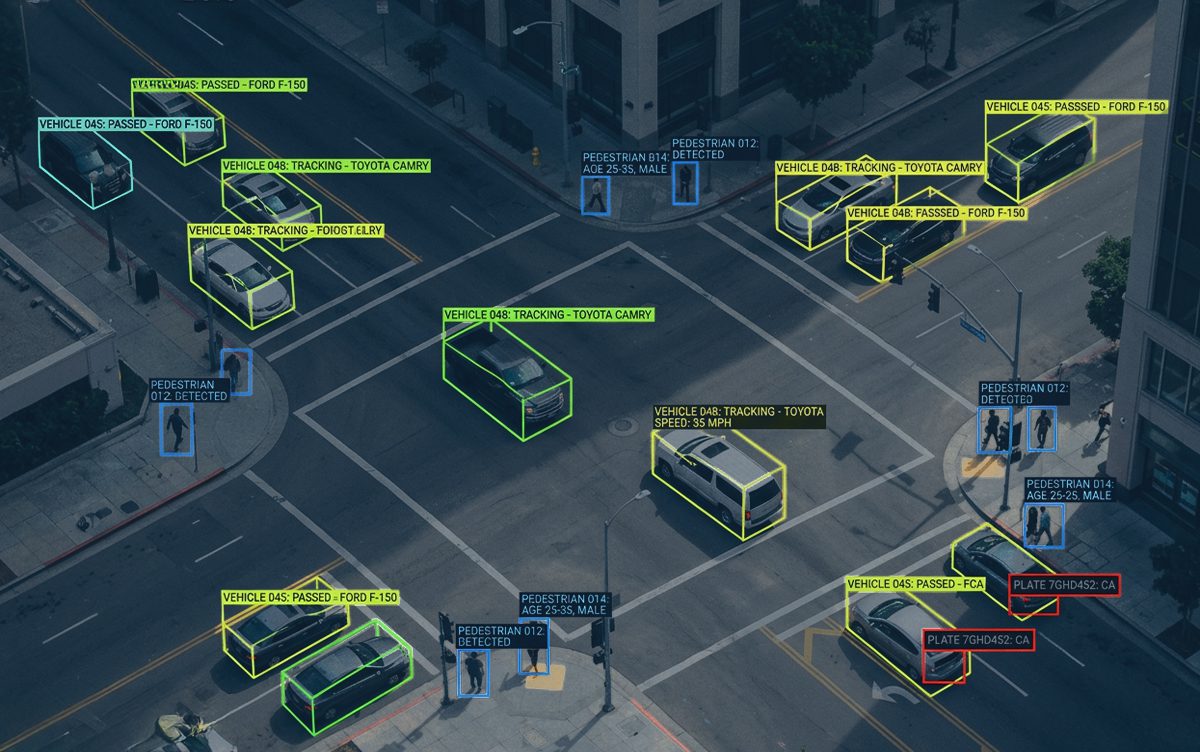
AI tracks targets by detecting objects in each video frame and predicting their next positions. Using predictive algorithms allows the process to be performed efficiently in real time, and the system can track targets even when they are partially hidden, moving fast, or changing appearance. Put simply, detection finds the object, tracking locks onto it, and prediction informs the system where it will go next.
The technology behind AI for video surveillance is complex, but it’s the integration that makes it truly exceptional for surveillance operations.
- Computer vision – Generally, to be able to perform its functions, AI has to ‘see’. Computer vision enables AI to analyse visual input from live video feeds. This lets it identify targets, spot visual clues, and analyse patterns such as crowd flow and traffic movement without a human operator having to analyse each frame. This data is then incorporated into the system through machine learning.
- Machine learning – AI doesn’t so much learn from programming parameters, but from experience. The more data AI processes, the better it becomes at spotting patterns and key triggers (such as gun recognition, facial recognition – where permitted under local regulations -and behavioural indicators). System performance can improve as more training data is processed, becoming more adept at filtering out erroneous information and ‘background noise’.
- Edge computing and real-time processing – Edge computing negates the need to send data to a remote server or the Cloud. Instead, data is processed at source and in real time. This results in faster alerts and a much lower bandwidth usage, making the system more economical.
- Integration with existing surveillance systems – AI surveillance systems are great, but if they cannot be integrated with existing systems, they become less economically viable. The most important aspect of artificial intelligence for video surveillance is that it can be integrated into many legacy systems and is both intuitive and user-friendly for human operators.
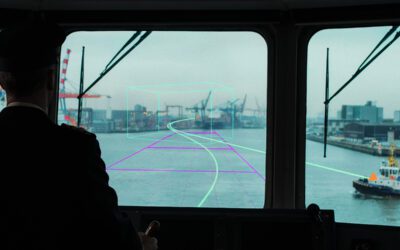
The field is evolving at an extraordinary rate. New and innovative surveillance technologies can be paired with AI for enhanced tracking and fully integrated with legacy systems to create bespoke mission consoles for a wide range of applications. For example, the use of autonomous drones provides ‘eyes in the sky’ that can be coordinated from a ground-based control centre and work in tandem with aerial and ground units.
Thermal and multispectral imaging give AI much more expansive computer vision, even at night and in poor visibility, and even allow external cameras to detect heat signatures associated with structures or partially obscured targets.
AI can now move beyond the need to use visual cameras, too. Radar-based human tracking uses radio waves rather than cameras to detect, follow, and interpret human movement. This means it can track targets without the need for visible light, even through smoke, fog, or haze.
Even human emotions can be used to analyse and assess surveillance targets. Some systems attempt to infer emotional states from facial-recognition patterns, deciding whether something falls into a ‘positive, negative, or neutral’ category. Again, the process uses pattern inference rather than any emotional response that a human observer may feel.
Key applications of AI for surveillance
AI surveillance systems have a role to play across a wide range of sectors, from civilian to military, and from law enforcement to SAR.
- Civilian – Surveillance in retail outlets, public areas and even on the street provides operators with continuous monitoring capability. It learns as it accrues more data and can work 24/7 even in low light conditions. There are concerns as to the ethical use of AI surveillance in the civilian arena, though, so any usage of AI surveillance has to be mindful of the individual’s right to privacy.
- Border control – AI surveillance can operate continuously. This makes it excellent for border control operations, where constant vigilance is required to identify any unusual activity.
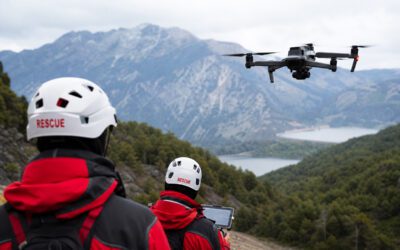
- Disaster response – Drones and helicopters fitted with AI surveillance systems have an advantage in disaster situations and search and rescue in that they can integrate with mission consoles to define target areas, use sensors to search for heat signatures, visual and non-visual clues to the location of survivors, and spot anomalies that could represent a danger to ground-based rescue teams.
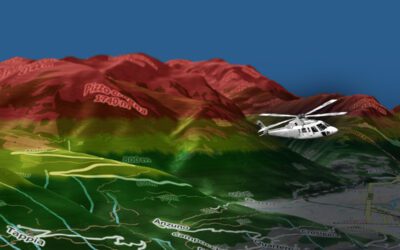
- Law enforcement and military target tracking – The use of surveillance technology in law enforcement has been adopted from military target tracking, using similar systems to locate, identify, and lock onto a target regardless of terrain. Most commonly used in helicopters and in aerial units such as unmanned drones, it has proven highly efficient at tracking targets even in the harshest terrain or the most complex urban settings.
OPENSIGHT – the next evolution in AI surveillance
AI surveillance systems have been around for a while now, but at the forefront of innovation is FlySight’s OPENSIGHT Mission Console platform. Rather than having a fixed system, FlySight recognised that adaptability is key for end users. As a result, the turnkey Mission Console platform can integrate bespoke surveillance capabilities to meet the user’s needs.
For example, OPENSIGHT’s Automatic Target Recognition uses a detection, classification, and identification protocol to collate data from a platform’s sensor bank, including the video feed, and applies Deep Learning to maximise performance. Fully compatible with legacy systems, it leverages GPU and CPU technologies and uses AI to identify and monitor targets.
You can find out more on our Automatic Target Recognition page. Browse our site for informative videos, brochures, and in-depth guides to OPENSIGHT. Or contact us direct to discuss your AI surveillance needs in more detail. Call us today.