The pace of technological advancement is astonishing. The rapid growth of the use of tools such as Augmented Reality and AI permeates all sectors and all industries, including avionics. Helicopter technology is also subject to this ultra-fast development, tempered only by security and, most importantly, safety aspects of vertical aviation.
The latest helicopter technology pushes the boundaries of not just engineering but also high-level electronics further than before, securing the industry’s position at the forefront of aviation innovation.
Advancements haven’t been purely limited to AI and Enhanced Reality, though. Operational hardware is undergoing a shift in development, and even the way helicopters are used is changing, alongside drone and no-operator technology. But do these advances really benefit operations, efficiency, and safety?
In this article, we’ll take a look at the latest developments and how helicopters are evolving in 2026 and beyond. We’ll examine the latest advancements in vertical aviation, including new technologies and those still in the developmental or even theoretical stages. We’ll also delve a little deeper into the use of Augmented or Enhanced Reality in avionics and how it’s playing a major role in creating operator-friendly consoles and enhancing images.
New helicopter technologies and features
New helicopter technology is a focused snapshot of the modern world, as much of the development has focused on incorporating AI and Augmented Reality. However, alongside electronic advancements, a cluster of new developments includes the use of eco-friendly materials and more sustainable manufacturing methods. Yes, even the aviation industry is ‘going green’.
It’s not just for the planet’s benefit, though, as many of these innovations also improve aircraft safety and operator comfort, elevating a unit’s efficiency and can contribute to improved endurance. The lighter the aircraft, the more fuel-efficient it is. The industry aims to use the latest helicopter technology to strike a workable balance between performance and operational use, while considering environmental factors.
Taking all that into account, what are the latest advancements in helicopter technology that we should be watching? Here are a few of the most significant.
X2 technology
Let’s start with some helicopter technology that could transform the performance of all vertical aviation platforms. Sikorsky Aircraft has been working on X2 technology for decades, proving just how time-consuming aviation development has to be to tick the safety box. X2 is primarily focused on speed, efficiency, and aircraft manoeuvrability and generally applied to new aircraft designs rather than legacy platforms. Applications span the spectrum of users, from the military to civilians, law enforcement, and SAR.
X2 helicopter technology includes several key elements, including:
- Coaxial rotors: Having two coaxial rotors in a stacked configuration, rotating in opposite directions, reduces the need for a tail rotor, providing greater control and stability.
- Pusher propeller: Positioning a pusher propeller at the rear of the aircraft introduces extra forward thrust, which in turn creates an aircraft that is considerably faster than standard rotor-based units.
- Fly-By-Wire controls: Fly-By-Wire uses complex electronics, including a vast array of sensors and onboard flight control computers, to improve handling and responsiveness. They are increasingly being used in modern helicopter designs and can help reduce operator fatigue, improving the unit’s safety and efficiency.
- Aerodynamic design: Reducing drag and increasing efficiency is the aim of all aeronautical designers. X2 helicopter technology looks not just at the internal operations, but also at the external design of helicopters.
The aim of X2 is to improve and expand helicopter capabilities through the use of ‘joined-up thinking’ – looking at all aspects of helicopter design, rather than focusing on individual components. X2 technology is more of a new approach to the design process, leveraging futuristic capabilities and technologies that focus on speed, manoeuvrability, and efficiency.
Electric and Hybrid Propulsion Systems
In a similar vein to the new direction the automotive industry is taking, aviation is seriously considering electric and hybrid propulsion systems for rotary aircraft. Rather than using a single ICE system, helicopters of the future could integrate multiple energy sources, including electric motors.
By using multiple power sources, including sustainable aviation biofuels and electricity (either singly or in tandem), it is hoped that aircraft will become more energy-efficient, have a lower environmental impact, and operate more quietly.
The issue at the moment is, of course, the range of EVs, which would severely limit a helicopter’s usability. While a laudable direction for helicopter technology, hybrid and EV systems in particular are still at a developmental stage. However, in the future, hybrid helicopter technology could result in greener vehicles with the same applications as ICE-powered machines.
AI-Assisted Flight Systems
If there is one helicopter technology that has made it from the drawing board to operational units, it’s AI-assisted flight systems. Projected to be worth almost $10 billion in the aviation industry alone by 2030, AI is infiltrating all levels of the business, from automating manufacturing and using Augmented Reality to speed up and simplify servicing, to onboarding systems designed to assist operators through comprehensive mission consoles.
Predictive maintenance using AI to analyse data from sensors and historical records can help to flag up potential issues and required maintenance long before the aircraft is adversely affected. This, in turn, improves both safety parameters and lowers maintenance and operating costs.
Onboard, AI plays a significant role in modern helicopter technology. Adaptive in-flight systems keep a close eye on the ‘health’ of the aircraft, notifying operators of any fluctuations in engine performance both during the mission and afterwards in post-flight assessments and maintenance. The speed at which AI operates, combined with connectivity to ground or cloud-based systems, enables systems to gather, process, and transmit large amounts of data, improving communications between ground-based and aerial units.
The ability to provide pilots and operators with mission-critical information also extends to the unit’s safety elements, where AI can alert a pilot to an emergency and present adaptive solutions and clear information. This allows the pilot to make informed decisions, even when under intense pressure, such as during an engine failure or malfunction.
Improved materials – Lighter, stronger, faster
The advent of lightweight yet incredibly strong materials seems to be a natural fit for the aviation industry. The lighter the aircraft, the less fuel it takes to get it in the air – a particularly key consideration for vertical flight platforms such as helicopters. Earlier lightweight materials posed challenges in durability and certification – they were often not strong enough to tolerate the extreme forces created by rotary flight.
While progress is being made to develop aeronautical materials such as composites and carbon fibre, immediate improvements can be made in more intelligent production methods on the ground. Sustainable construction makes good use of raw materials to improve the durability of components. This includes the use of ceramic coating (something that has once again been driven by the automotive industry and is now being adopted by other sectors) and natural fibres, which could deliver strong yet lightweight non-critical components.
It’s a different aspect of the latest helicopter technology, but one that will become a greater focus within the industry in the future. Advanced ceramics are already being integrated into exhaust systems, demonstrating that lightweight materials are available that can withstand the mechanical stress and extreme temperature variations required for safe operation within a rotary aviation unit.
Human-focused technology – FlySight’s OPENSIGHT Mission Console
There’s one component of a helicopter that is the focus of the current wave of helicopter technology – the crew. The latest helicopter technology that’s having the greatest positive impact on the progression of rotary aviation is human-focused. This is achieved using AI and Augmented Reality that assist crews in carrying out their jobs with less effort, less fatigue, and greater accuracy.
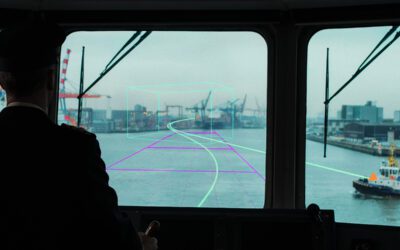
AI capabilities for operations such as target recognition and classification, enhanced video processing algorithms for display image enhancement, and vector overlay on mission consoles give users greater spatial awareness. Practical tools such as dehazing software provide pilots with far better clarity when operating in difficult weather conditions or over disaster areas where the air may be contaminated with smoke.
The key takeaway from these technological advancements is that they can be integrated into legacy systems using familiar control systems. Not only does this make the technology user-friendly but may lead to reductions in the unit’s overall weight. A computer chip weighs far less and takes up much less space than an entirely new console.
Leading the way in human-focused helicopter technology is FlySight’s OPENSIGHT Mission Console. It adopts a modern approach to upgrading existing systems by introducing a modular console with ‘plug-ins’ that allow end users to tailor the console to their exact needs. This will depend on the operational applications, such as Search and Rescue, law enforcement, or other civilian uses.
For example, in SAR operations, multispectral imaging with heat-sensitive cameras may be used to locate survivors in open or urban terrain. Law enforcement operators may find the target acquisition and tracking systems highly beneficial. The key advantage of OPENSIGHT is its adaptability and ability to integrate with existing operational setups.
You can find out more about FlySight’s OPENSIGHT Mission Console by visiting our OPENSIGHT Mission Console webpage and watching our informative videos. Alternatively, you can contact us direct and speak to one of our team in complete confidence to see how OPENSIGHT could work for you. Call us today.